Talking Generations was created in response to one of the greatest public health challenges of our time – loneliness and social isolation. Affecting people of all ages, from teenagers under pressure at school to older adults facing the quiet of an empty home, it diminishes health, hope and belonging. But loneliness is not just about individuals; it is fuelled by divides between communities, stereotypes that separate young from old, and stigma that keeps people from seeking connection.
The scale is stark. Over 3.8 million adults in the UK report chronic loneliness, while one in five young people say they often feel lonely. Loneliness increases the risk of early mortality by 26%, equivalent to smoking 15 cigarettes a day, and is linked to dementia, heart disease, depression and anxiety. The economic impact is significant too, costing employers an estimated £2.5bn annually.
For IMM and IE, the answer is clear. Talking Generations exists to challenge the siloes in which we too often view society – young and old, health and housing, education and care – and to build communities where people of all ages are connected, valued and supported. It focuses on creating spaces that bridge divides and dismantle stereotypes, so connection across generations becomes the foundation of healthier, fairer communities.
As practitioners, campaigners and connectors across health, social care, housing, education, culture and community life, we have seen both the damage of disconnection and the transformative potential of intergenerational practice. Rooted in dialogue and empathy, Talking Generations emerged not as a set of one-off activities, but as a strategic movement embedded in the systems and strategies shaping everyday lives.
Getting off the ground
The campaign’s roots were in creative health, intergenerational solidarity and community engagement. Since 2018, IMM has delivered projects that unite generations through choirs, youth social action, hubs, training and community events. IE was established to bridge practice and policy, challenging the structural barriers that create division and advocating nationally for an intergenerational approach across policy and practice.
Together, IMM and IE form a powerful ecosystem combining hands-on creativity with thought leadership, research and advocacy. Talking Generations sits at the heart of this partnership, acting as the bridge between IMM’s delivery and IE’s strategy. Early partners included schools, care homes, libraries, train stations, cultural venues and Integrated Care Systems (ICSs). We also worked with voluntary organisations, universities and community networks, recognising that intergenerational practice must be embedded across every layer of society.
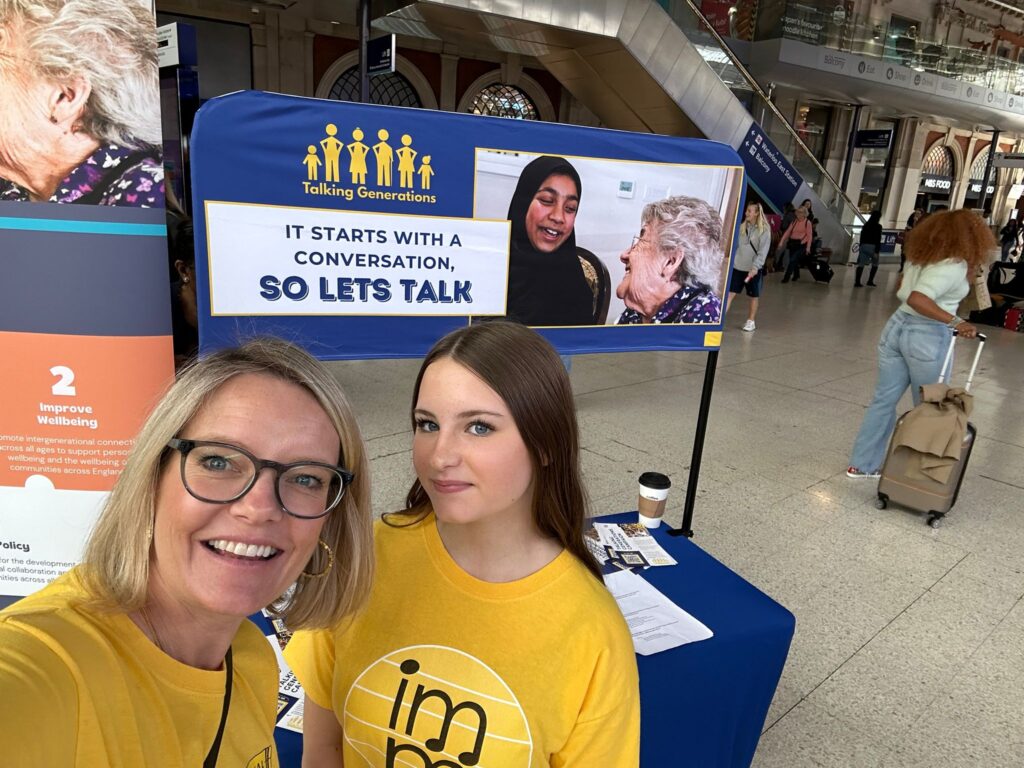
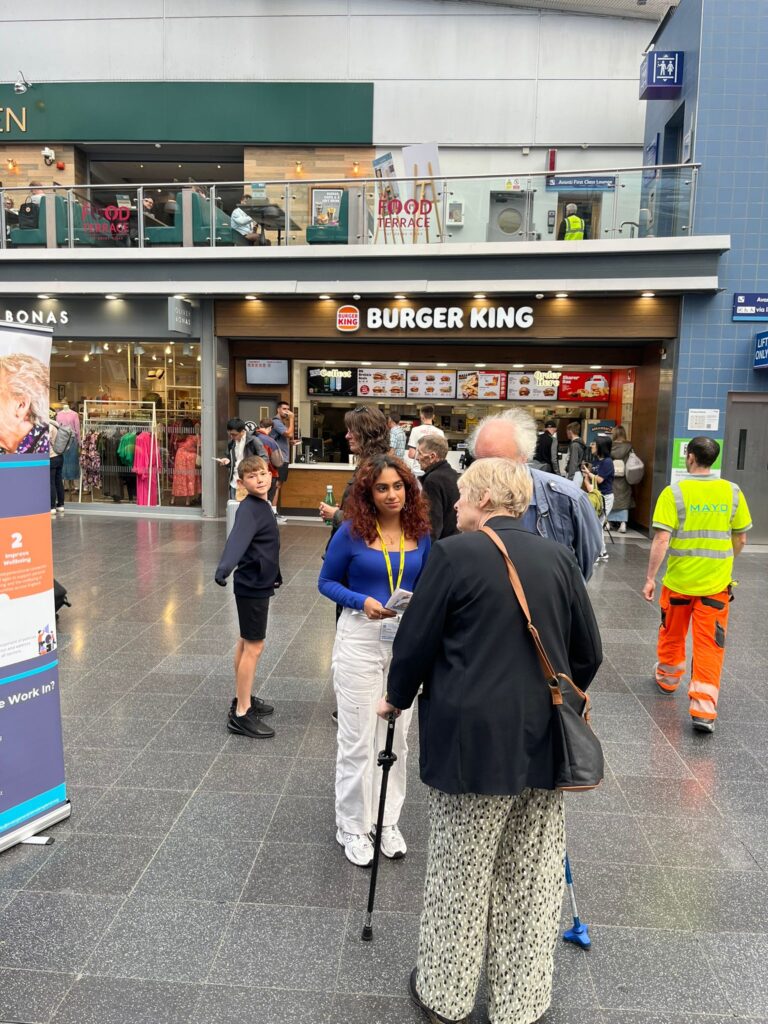
A breakthrough came with our interactive pop-up installations in train stations and libraries. Commuters, families and older adults paused to share stories and reflect on connection. These prompts led to national media coverage, sector recognition and real human conversations. From the outset, inclusive leadership was central. We brought together councils, NHS teams, housing providers, schools and voluntary organisations to create a framework where intergenerational practice became a necessary part of tackling health inequalities.
How it works
At its heart, Talking Generations is about shifting both practice and perception.
It works on three interconnected levels:
- Community activation – creative workshops, innovation labs and public installations that bring young and old together in shared spaces, sparking dialogue and belonging.
- Sector dialogue – working with partners across health, housing, education and the workplace to embed intergenerational practice into everyday strategies. This includes workplace focus groups, the Let’s Talk webinar series, and the Talking Generations People Panel, alongside collaborations with ICSs, councils, schools, care homes and voluntary, community and social enterprises (VCSEs).
- Policy and evidence – strengthening the national and global case for intergenerational work through research, reports and frameworks, combining lived experience with academic insight.
For participants, the experience is rooted in conversation and connection. It might mean sharing stories on a podcast, co-creating art in a station, joining a library activity or simply talking on a park bench. Each anchor is shaped by people and their communities, designed to build empathy, spark storytelling and shift perspectives across generations. For those delivering it, whether councils, NHS partners, housing associations or voluntary organisations, the campaign offers a structured yet flexible model that integrates into existing wellbeing and care strategies, while creating new spaces for dialogue and connection.

Development and reach
Since inception, Talking Generations has developed from grassroots creativity to a recognised movement shaping national agendas. We have worked intensively across Manchester, London and Surrey with councils, NHS teams and local VCSEs. Together we have tested what it means to adopt an intergenerational lens: asking every system, ‘Does this policy, service, or intervention bring generations together rather than keep them apart?’
We are proud to act as Secretariat to the All-Party Parliamentary Group (APPG) on Tackling Loneliness and Connected Communities, ensuring intergenerational perspectives inform parliamentary debate. Our IE research report A Divided Kingdom highlighted fractures between age groups and Talking Generations has been our active response – a campaign of solidarity, connection and shared purpose.
To strengthen the evidence base, we partnered with the Housing Associations’ Charitable Trust (HACT) to create the first social value measurement framework for intergenerational approaches, giving councils, housing providers and health systems a concrete way to measure connection. Beyond the UK, IE is working globally, including with the World Health Organization (WHO), to align intergenerational practice with international health and wellbeing strategies.
Challenges and resilience
Like any ambitious campaign, Talking Generations faced challenges. One was scepticism – some questioned whether intergenerational work could be more than ‘feel-good moments’. We responded with evidence, demonstrating improved mental health outcomes, measurable increases in social interactions and reduced loneliness. Embedding the work into overstretched health and care systems was another challenge. By aligning with NHS priorities, prevention, integration and tackling inequalities, we demonstrated that intergenerational approaches are a practical, cost-effective strategy.
The model directly supports NHS goals by addressing wider determinants of health such as housing, education and community resilience. Through community-led anchors, from schools and GP surgeries to libraries and train stations, it creates preventative pathways that ease pressure on acute services, reduce demand on frontline staff and improve overall wellbeing.

Outcomes
The outcomes have been both deeply human and strategically significant:
- Community engagement – over 15,000 people directly involved in intergenerational activities; over 60,000 reached through public engagement and digital platforms.
- Wellbeing impact – 85% of older adults reported improved wellbeing; 78% of young people reported greater empathy and understanding.
- Shifting attitudes – eight in 10 UK adults agree intergenerational connection reduces loneliness, improves wellbeing, builds mutual respect and helps break down stereotypes.
- Systems change – activities embedded in 50+ care homes, 30 schools and multiple ICS strategies.
- Policy influence – contributions to NHS 10 Year Health Plan, local authority strategies and APPG debates.
- Sustainability – thriving networks in 12 communities continuing independently.
- Global reach – partnerships with WHO and international research into intergenerational solidarity.
Vision for the future
Our vision is bold yet achievable – a society where intergenerational connection is woven into the fabric of everyday life and policy. We see Talking Generations evolving into a nationwide and international movement that reshapes how we think about care, community and belonging.
Winning the Dame Esther Rantzen Campaigning for Change Award has recognised the thousands of individuals, partners and communities who have made Talking Generations what it is.
Nominations for the Markel 3rd Sector Care Awards 2026 are open now! Click here for more information.
Charlotte Miller and Emily Abbott are Co-founders of Intergenerational England and Director and Programme Director respectively at Intergenerational Music Making. Email: [email protected] and [email protected] LinkedIn: @Charlotte-Miller-Intergenerational-England and @Emily-Abbott-Intergenerational-England